
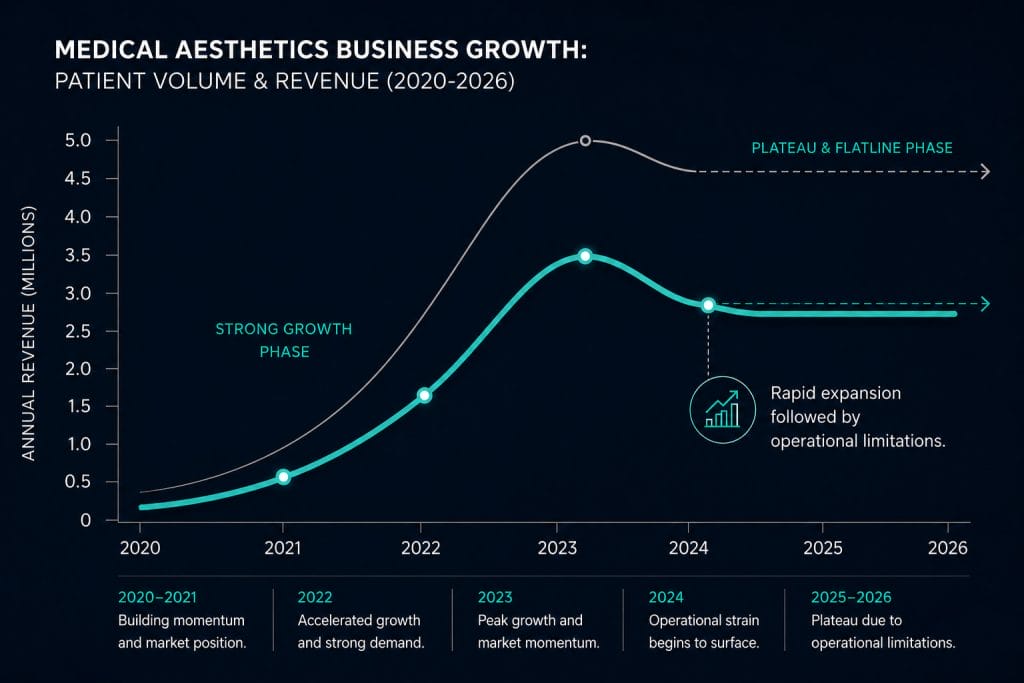
The trajectory of a medical aesthetics practice is often defined by an initial surge of momentum. When an office is established by the will and drive of a surgeon or owner with a clear vision, the energy is palpable.
Reputation builds, referrals increase, and the schedule begins to solidify. While the timeline for this takeoff varies, that early momentum eventually meets a critical inflection point.
For a period, growth appears to move by its own power, sustained by clinical skill, founder energy, and a high-touch patient experience.
Then the pattern begins to change.
In my observation operating and advising practices, the plateau rarely shows up first in a spreadsheet. It usually appears after office hours, when the day is over and the mental toll begins to settle in. Owners, injectors, and team leaders start replaying the day and asking themselves difficult questions.
Why does the practice feel harder to run than it did six months ago?
Why are consults not converting at the same pace?
Why does the patient experience feel flatter than it used to?
These questions are familiar to nearly every growing practice. They usually point to something deeper than one weak employee, a missed follow-up, or underperforming marketing. More often, they are early signals that operational complexity has begun to outpace the infrastructure supporting the business.
The Weight of Complexity
As practices expand, complexity spreads across the organization. Teams become larger, patient volume rises, and daily decisions multiply across scheduling, communication, treatment planning, and staffing coordination.
What once felt manageable begins to feel heavy.
Without structured operating systems in place, growth is managed through reaction.
- Calendars are adjusted on the fly
- Patient questions are answered inconsistently
- Consultation flow starts to vary by coordinator
- Office managers carry too much institutional memory in their head
This is the moment when the practice begins to shift from elevated to reactive.
The Consequence of the “Flat” Experience
Patient experience does not collapse overnight. It begins to drift. It rarely breaks in a single moment. It changes gradually, often unnoticed at first.
The consultation may feel slightly rushed. Follow-up may become inconsistent. Communication may depend too heavily on who happens to be working that day. Small breakdowns start to accumulate, and staff members feel the strain long before leadership sees the full pattern in the numbers.
One of the clearest signs of a plateau is the burden placed on office staff.
Front desk teams and patient care coordinators begin spending more of the day reacting than improving the experience. Instead of reinforcing standards, they are putting out fires. Instead of creating consistency, they are managing exceptions.
When a patient senses that the experience no longer feels as coordinated or attentive as it once did, the opportunity quietly opens for another practice operating with stronger infrastructure.
When that patient finds an office where the service feels organized and reliable, loyalty follows. At that point, the consequences extend beyond a single appointment. The patient acquisition cost invested in attracting that individual may be lost. The lifetime value of that patient may disappear. That patient may also recommend the new practice to friends and family, further compounding the impact.
Lessons in Consistency
Organizations such as Four Seasons, Ritz-Carlton, and Hillstone Restaurants (Houston’s) have built powerful brands on consistency. Whether a guest visits a hotel in another city or dines at a restaurant in a different state, the experience feels remarkably familiar. The standards hold. The brand earns trust through repetition.
That consistency is not accidental.
It is the product of established operating systems and playbooks that guide how the organization functions. Those systems allow them to reproduce the same level of service and experience again and again, regardless of location or growth.
Consistency becomes the brand’s greatest strength.
The same principle applies to medical aesthetics.
Growth places increasing pressure on the systems that support the patient journey. Without infrastructure, maintaining a consistent experience becomes more difficult as the organization expands. Staff members feel more strain. Leaders become more reactive. Patients begin to sense the drift. Growth slows, even while effort increases.
The AXIS Operating System (AXIS OS)
The next stage of growth does not come from working harder alone. It comes from installing structure. High-performing practices move through this phase by building operating infrastructure that creates clarity across leadership, staff coordination, and daily execution.
The AXIS Operating System (AXIS OS) was designed specifically for this stage of growth.
By introducing leadership frameworks, operational systems, and role-based playbooks, AXIS OS helps practices bring structure to decision-making and patient communication. These systems allow leadership teams to move from reactive operations to a deliberate and disciplined way of running the business.
Practices that install a structured operating system early are better prepared to maintain consistency while navigating the operational complexity that naturally accompanies scale.
When operational infrastructure is misaligned with the scale of the business, growth is compromised. Implementing the AXIS OS provides the structure required to sustain consistency, protect the patient experience, and support long-term growth.
